How fairy chimneys formed: volcanoes, tuff and erosion
How Cappadocia's fairy chimneys formed: eruptions of Erciyes, Hasan and Melendiz, layers of tuff, harder caps and erosion, with Nevşehir frost and rain figures.
Published · Updated · 6 min read · Murat Yavuz
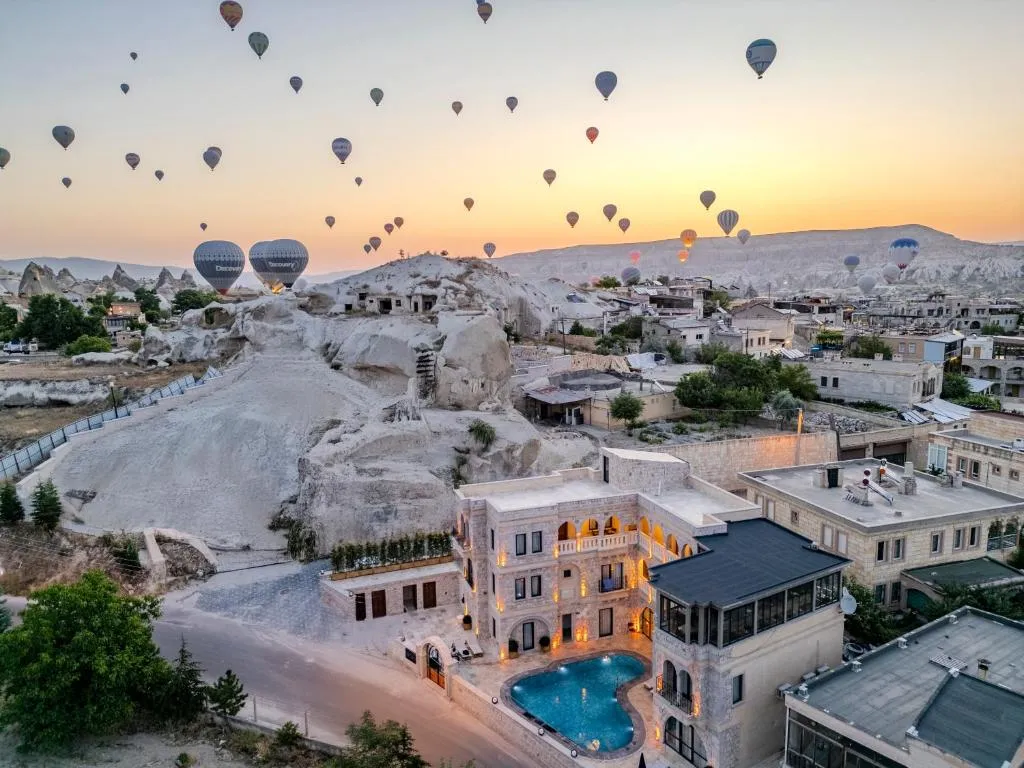
Fairy chimneys formed in three steps: volcanoes covered the plateau with ash and ash-flow deposits, the deposits hardened into soft rock called tuff with harder layers on top, and water, frost and wind then wore the plateau away, leaving columns where a harder cap shielded the softer rock below. This guide explains the steps in plain terms, shows the Nevşehir weather that keeps the erosion going and says why the same rock could be carved into rooms. It gives no ages for any particular chimney, because none is certain.
Fire first: the eruptions
The plateau sits among volcanoes. Mount Erciyes, near Kayseri, rises on the eastern side and can be seen from Uçhisar: Karlık Cave Suite lists a view of it. Mount Hasan stands to the south-west, near Aksaray, and the Melendiz group lies between. Over several million years, from the late Miocene into the Pliocene, repeated eruptions spread ash and glowing ash flows across the land.
Ash that settles and hardens becomes tuff, and the deposits made by ash flows are called ignimbrite. The key point is that the layers were not alike. Some were softer, some harder; in places lava flows or harder ignimbrite lay on top. A landscape built that way is ready to be carved by something else.
Water, frost and wind: the carving
Rivers and rain cut valleys into the plateau, and the shape of the valleys follows the soft layers. Frost does the fine work. Water that seeps into cracks freezes, expands and splits the rock, and thaws again, and the cycle repeats. The Nevşehir averages show where that happens:
| Month | Average high | Average low | Rainy days | Precipitation |
|---|---|---|---|---|
| December | 6.2 °C | −1.3 °C | 12.3 | 48.4 mm |
| January | 4.0 °C | −3.6 °C | 12.3 | 45.4 mm |
| February | 5.5 °C | −2.6 °C | 12.1 | 41.1 mm |
| March | 10.3 °C | 0.7 °C | 13.1 | 48.1 mm |
| July | 28.5 °C | 13.7 °C | 2.3 | 9.4 mm |
Source: Turkish State Meteorological Service (MGM), Nevşehir, 1959–2025. In December, January and February the average day ends below freezing and starts above it, so in the average winter the rock is wet and then frozen, again and again. The snow record is 64 cm, on 2 February 1992. In July the same rock bakes and dries, with about 9 mm of rain. Wind carries away the loose grains. None of this is fast, but it does not stop.
Why a chimney stands
Where a block of harder rock lies on softer tuff, it works as a roof. Rain runs off the cap and wears away the ground around it, and the rock under the cap is spared. As the surroundings erode, a column is left with the cap on top: a fairy chimney. Where there is no cap, the same slope erodes into a smooth cone. When a cap finally falls, the column below weathers much faster. That is why you see chimneys of every height and why some wear shapes that look like mushrooms or hats.
Different valleys show different stages. Love Valley is walked for its tall columns, Paşabağ for chimneys with several caps and Devrent for shapes that look like animals.
Why people could carve it
Fresh tuff is soft enough to cut with simple tools yet firm enough to stand as a room. People carved houses, storerooms, dovecotes and churches into it for centuries, and the same rock makes a cave hotel; what is a cave hotel describes the result, and the rock churches guide the oldest uses. The softness has a cost. The same erosion that shaped the chimneys cracks old rooms, and rockfall is the reason usually given for the evacuation of rock settlements such as Zelve.
What the hotel records say
Eight of the 80 records mention fairy chimneys, one only in its name. Local Cave House says seven fairy chimneys stand around it, and Panoramic Cave Hotel says its rooms sit inside natural caves and fairy chimneys. Travellers Cave Hotel has hilltop terraces facing them, and Flavia Cappadocia Hotel is described as close to them. No record gives an age or a height for any chimney; ask your hotel which ones it stands beside.
What carved rock means for a stay
Many cave rooms are cut into the same tuff, and rock is usually said to hold a steadier temperature than a thin-walled building. The records do not measure this, so treat it as a general expectation and not a promise. What they list is equipment:
| Amenity ticks in the 80 records | Records |
|---|---|
| Air conditioning | 48 (35 of the 54 cave hotels) |
| Heated floors | 4: Nujel’m Cappadocia, The Calypso Cave, Vita Cave Suites, Zara Cave Hotel +10 |
| Fireplace rooms (amenity tick) | 1: Leda Stone House |
The texts go further than the ticks: Kayata Cave Suites lists heated floors among its highlights, Local Cave House calls its rooms heated and air-conditioned, and Seki Cave Hotel says each of its 16 rooms has a fireplace. No record gives a room temperature. The January average low is −3.6 °C (MGM), so in winter ask how a room is heated, and in July ask how it is cooled.
Seeing them safely
- Stay on paths and behind fences. Soft rock cracks and falls; a fenced area is closed for a reason.
- Do not climb, lean or carve. A chimney’s cap protects it, and a climber can break it.
- Choose your light. Low sun brings out the colour in the tuff, early and late in the day.
- Watch the season. Ice and wet clay are slippery from December to March, and July heat has no shade.
- Wear shoes with grip. Paths in the valleys are uneven.
Where to stay
For a base among the formations, Local Cave House has 12 rooms around seven fairy chimneys, heated and air-conditioned, with a pool cut into the rock. Panoramic Cave Hotel has a sun terrace over the chimneys and rooms in natural caves. Travellers Cave Hotel has hilltop terraces facing them. Soho Cappadocia, pictured at the top, has a garden, a bar, a hot tub and a seasonal pool. After choosing, you can book through gocappadocia.com, the regional booking platform created through the combined efforts of 175 Cappadocia hoteliers, with a best-price guarantee; this guide takes no commission.
Questions answered in this article
What is a fairy chimney?
A column of rock left standing as the softer rock around it wore away, often topped by a cap of harder stone. In Turkish it is a peribacası. Fairy chimneys come as cones, columns and mushrooms.
Which volcanoes made the rock of Cappadocia?
Mount Erciyes near Kayseri, Mount Hasan near Aksaray and the Melendiz volcanic group, among other vents. Repeated eruptions laid down thick layers of ash and ash-flow deposits over several million years.
How long did the fairy chimneys take to form?
The volcanic layers built up over millions of years; the chimneys are the product of erosion since, and the shaping continues. We give no figure for the age of any particular chimney.
Why could people carve the rock?
The tuff is soft enough to cut with simple tools yet firm enough to stand as rooms. That is why houses, churches and storerooms were carved into it for centuries, and why cave hotels exist.
Are fairy chimneys still changing, and is it safe to climb them?
They are still eroding, and rockfall is the reason rock settlements such as Zelve were left. Do not climb them; keep to marked paths and follow any fencing.
Sources
- UNESCO World Heritage List No. 357, "Göreme National Park and the Rock Sites of Cappadocia" (1985): https://whc.unesco.org/en/list/357/
- Turkish State Meteorological Service (MGM), Nevşehir climate statistics 1959–2025 (temperature, rainy days, precipitation, snow record)
- Göreme Suites hotel catalogue, October 2026: 80 records searched for fairy chimney and natural cave wording (8 mention fairy chimneys; from gocappadocia.com hotel pages)
More from the guide
Devrent (Imaginary Valley): the rocks that look like animals
Devrent Valley between Ürgüp and Avanos: the camel rock and other animal-shaped formations, a short stop with no churches, how to fit it in, and the 9 Ürgüp hotels.
Love Valley: the easy walk among the tallest fairy chimneys
Love Valley (Aşk Vadisi, Bağlıdere) between Göreme and Uçhisar: a flat-floored walk among tall fairy chimneys, the roadside viewpoint, and the 3 hotels that name it.
Paşabağ (Monks Valley): the fairy chimneys with many caps
Paşabağ, the Monks Valley beside Zelve and Çavuşin: chimneys with several caps on one stem, the hermit chimney, how to pair it with Zelve and Devrent, and hotels.